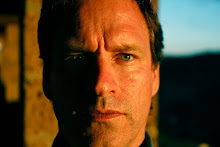
On Friday May 1, I graduated from the Ted Scripps Fellowship in Environmental Journalism. It was an amazing year, and I will be counting the gifts that come from it for the rest of my life. In nine months, I took six graduate school courses in six departments: Philosophy, law, religious studies, journalism, art history and biology. I also took a class on yogic meditation at Naropa University, one of two Buddhist universities in the United States. Being back in school as an adult was fun; I didn't feel any of the pressure or anxiety I did during the first go around. At this point, I realize how much a privilege learning is, and what a joy.
At times, though, what I learned was a grim litany. I already had a strong sense that the Earth is in a period of transition; that human industry has transcended the forces we normally think of as nature as a driving force of planetary change. But week after week, as we met with the nation's top scientists on climate change (primarily from National Oceanic and Atmospheric Administration and the National Center for Atmospheric Research, both based here but also from the University of Colorad0) we heard things are worse than the public knows. The scientists we met weren't polemicists or demagogues, they were quiet people who study the historical record, who analyze variables and look at the conclusions. To a person, they all said we're cooked, the question is how bad will it be?
This isn't the place to go into the specifics. But we all have to face the question of what to do. Consume less and reproduce less are the most immediate and practical answers. There is a temptation to throw up one's hands because the task is so enormous. It's worth trying though. Every act of love, every stretch of the imagination, every breath, in fact, brings home the beauty of the world, and to the point that we are a part of it, not apart from it.
Tuesday, May 5, 2009

Monday, April 27, 2009
The flight of time

This is the last week of my fellowship at the University of Colorado at Boulder. As I age, time accelerates. I have felt this acceleration acutely in the past few weeks. As a function of a human life, this is a natural outcome. The more days we live, the smaller each day gets in the scheme of our whole existence. I have a specific, early memory, of how much slower time was when my life was so much shorter. When I was 5 years old, lying in the grass and watching an ant colony, a few hours of careful observation represented what a few days does now, as a proportion of my total life. Yesterday, our apple tree was in full bloom, and when I went outside at sunrise to pick up the paper, the sight of it froze me. Beauty that intense pulls me into the moment and out of the constant monologue in my head. Last night, three inches of wet snow fell, and the apple tree now is a doubly intense vision of ephemera. Today, the snow will melt, and tomorrow, the blossoms will fall.
Silke held up one of my jackets to make a background, and I took a photo. The woman holding the jacket is as much a part of the image as the flowers, calling out to bees.
Thursday, April 2, 2009
Traveler's Eye Workshops: A mobile school for photographers

The fortified town of Orvieto occupies a tower of volcanic tufa on the road between Rome and Florence. Within the walls of the old city, no cars are allowed. On a pedestal help up to the sky, the city moves at a slower pace than much of the rest of motorized, industrialized Italy. My friend and colleague Richard Sennott proposed that we start a photo workshop in the town, using the San Lodovico convent as a base. The medieval cloister has frescoes thought to be painted by Michelangelo, the food is traditional Umbrian peasant fare, the rooms simple and clean. So, Traveler's Eye Workshops was born. We're running our first trip June 13, with two more to follow in September. The September trips are filling up fast.
Monday, March 30, 2009
The price of paradise in Costa Rica

Here's my last story as a staff writer and photographer at the Star Tribune. After 22 years, 50 countries, 45 states and most of the counties in Minnesota, I probably deserved the chance to say so long in a more formal way; but in the January round of buyouts, the managers didn't let reporters say goodbye to the readers. They didn't want any reminders of the paper's ongoing diminishment. No sour grapes though; this story was a fitting send-off. In my career, I was fortunate to have the freedom to write as I saw fit, to cover the dark side of travel as well as its joys. The over-developed, under-policed Costa Rican town of Tamarindo would be an excellent subject for a dissertation on what can go wrong when a tourist town doesn't plan carefully to protect its own soul.
Experiments
 Our tiny cabin has taught us to live simply, and made it easier to balance in handstand.
Sunday, March 29, 2009

Sand and light
 An assignment to write about the 22 religious communities that have settled in Crestone, Colorado, took me to the San Luis Valley, near the border with New Mexico. The valley is pool-table flat, suspended at 8,000 feet between two 14,000 foot mountain ranges. Rivers and streams carry broken rock and gravel down from the high peaks, and winds from the southwest carry them back toward the Sangre de Cristo mountains. Over thousands of years, this pattern has built an area of sand dunes that covers 30 square miles and is as high as 750 feet. After spending several days visiting temples, we spent a day at the dunes. Even in a howling windstorm, it was spectrally beautiful. As the sun pushes shadows across the sand, shifts in light and dark create a dynamic flow. The streams and fuzziness along the sharp seams in this photo are grains of sand, carried into flight by the wind.
Subscribe to:
Posts (Atom)